
You've got the trucks. You've got the crew. You know how to move people. But the phone isn't ringing as much as it should be, and the jobs you do get feel more like luck than a system. Is that your story?
Most moving companies are great at the actual work, but haven't figured out how to get a steady, reliable flow of new customers. Word of mouth carries you for a while, but it has a ceiling. One slow season and you're stressing about payroll. One competitor who figures out online marketing before you do, and suddenly you're watching your market share shrink.
The good news is that lead generation for a moving company isn't some complicated mystery. It's a set of practical strategies that, once you understand them, are completely within your reach. This guide breaks all of it down, including what works, how to do it, and what it actually takes to make it consistent.
Before we get into the playbook, it helps to understand why so many movers hit a wall with lead generation. The problem usually comes down to one of three things.
They rely on a single source. Word of mouth is great until it isn't. Referrals from family and friends are unpredictable. You can't control the volume or the timing. When business slows down, there's no backup.
They pay for shared leads and hope for the best. Platforms sell the same lead to multiple companies at once. You're not getting a customer. Instead, you're getting a race. You have to call faster, quote lower, and still lose half the time. The margins get thin fast.
They have no online presence. Here's the reality. The first thing most people do when they need a mover is open Google and type ‘moving company near me’ or ‘movers in [city].’ If your business doesn't show up in those results, you simply don't exist to those customers. They'll book whoever does show up.
The companies that consistently generate leads have stopped relying on luck or third-party platforms. They've built a presence that works for them 24/7, bringing in new customers even when they're busy running jobs. That's exactly what this guide is about.
This might sound basic, but a lot of moving companies skip it and pay the price later. Not every customer is the same, and if you try to speak to everyone, you end up speaking to no one.
Think about the different types of people who hire movers. You've got residential customers doing local moves for families, young professionals, and apartment renters. You've got businesses making long-distance moves across state lines.
Each group has different needs, different budgets, and different reasons for choosing one mover over another. When you understand who you're talking to, every other part of this guide gets sharper. Start here before you do anything else.
Your website is your most important sales tool. It works around the clock, it's the first impression most customers get of you, and it's where every other marketing effort lands. A weak website means wasted money on everything else.
Here's what a lead-generating moving company website actually needs.
A clear headline that says what you do and where: ‘Reliable Local Movers in Phoenix, AZ’ beats ‘Welcome to Smith Moving Company’ every time. Visitors decide in seconds whether they're in the right place.
A quote from above the fold: Visible without scrolling. Ask for name, phone, move date, and zip codes, and nothing more. Every extra field you add drops completions.
Mobile optimization: Over 60% of all Google searches happen on a phone. If your site is clunky on mobile, people leave immediately, and Google ranks you lower for it.
Fast load speed: Bounce rates can increase by 32% if load times reach three seconds. At 5 seconds, it can jump by up to 90%, showing why you must prioritize this. Use Google PageSpeed Insights to check yours.
Trust signals: Show your USDOT number, insurance info, years in business, and real photos of your crew and trucks. People are handing you their entire home. They need to feel safe before they call.
Separate service pages and location pages: One page for local moving, one for long-distance, one for packing, and so on. If you serve multiple cities, each city gets its own page. This is what gets you found in searches across your whole service area.
A CTA on every page: Add CTAs like ‘Get a Free Quote’ and ‘Call Us Today.’ Don't make people hunt for how to contact you.
Let’s first understand the difference between regular SEO and local SEO, because they're not the same thing.
Regular SEO is about ranking on Google for broad searches, things like ‘how to pack for a move' or ‘moving company tips.’ These are national or general searches that anyone in the country might type.
Local SEO is about ranking for searches with geographic intent, things like 'movers in Denver' or 'moving company near me.' The person searching wants to hire someone in their city, today or soon. That's your customer.
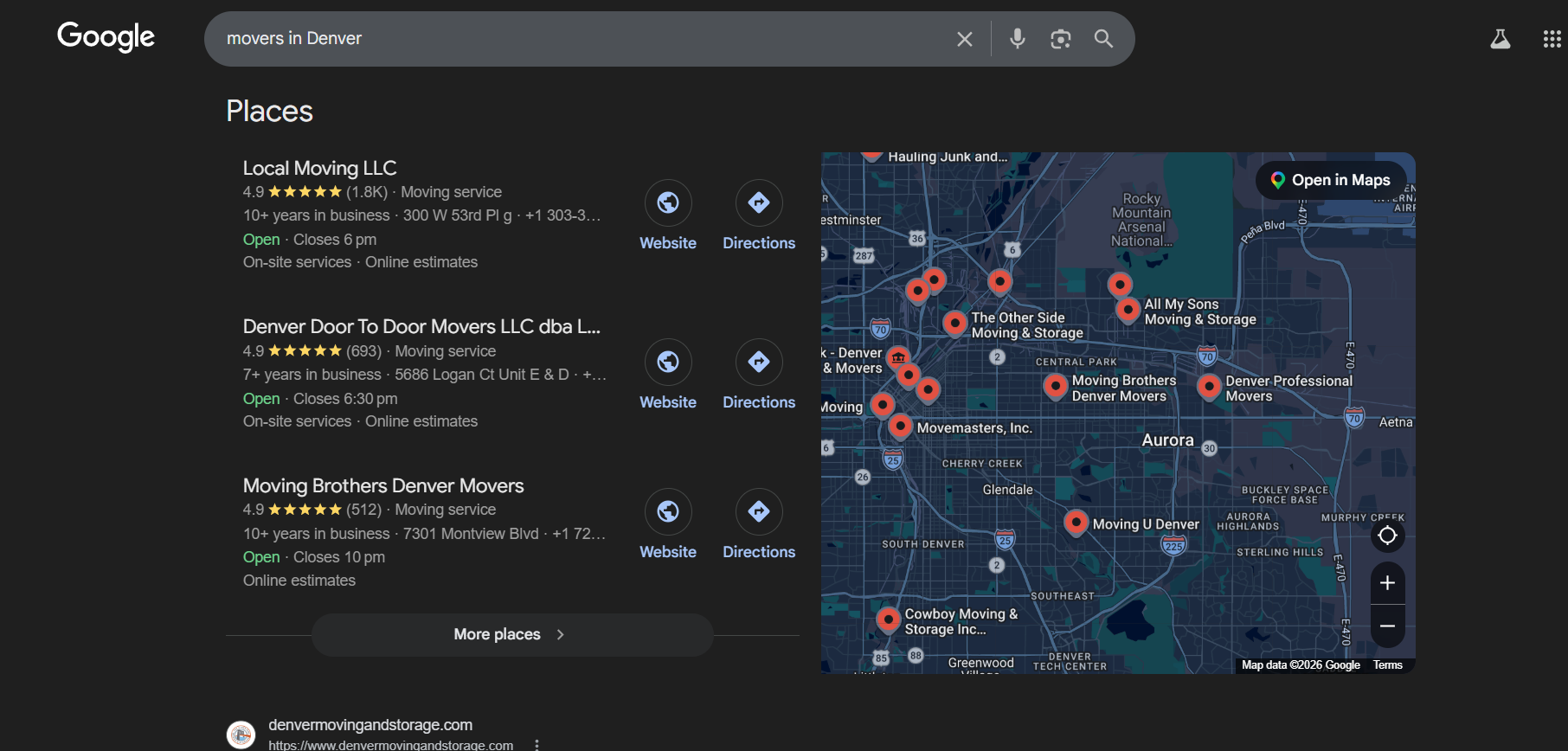
Here’s what moves the needle:
Google Business Profile. This is the free listing Google gives every business. Claim it at business.google.com, fill out every field, and upload real photos of your trucks and crew. Most moving companies either have not claimed it or have left it half-empty. This profile is often the first thing a potential customer sees before they ever visit your website.
Consistent business information everywhere. Your name, address, and phone number need to be identical across every directory. Even small differences confuse Google and quietly hurt your rankings.
Keywords on your website. Target phrases like '[city] moving company,' 'local movers [city],' and 'apartment movers [city].' Work them naturally into your page titles, headings, and content.
One more thing worth knowing is that search behavior is shifting. People are now skipping Google entirely and asking AI assistants like ChatGPT, Gemini, and Perplexity to recommend service providers directly. That is what AEO (Answer Engine Optimization) and GEO (Generative Engine Optimization) address.
It is not replacing local SEO, but it is becoming a meaningful second channel for discovery. The moving companies that get ahead of it now will have a real advantage as this behaviour grows.
SEO is the long game. Google Ads gets you to the top of search results right now. You pay each time someone clicks, and the people clicking are actively looking to book a move.
Two formats matter most for moving companies:
Google Local Services Ads appear at the very top of the page, above everything else, with a 'Google Guaranteed,' or now changed to ‘Google Verified,’ badge. You go through a quick verification (license and insurance check) to qualify. You only pay when someone contacts you through the ad, not just when they see it. For moving companies, these convert very well.
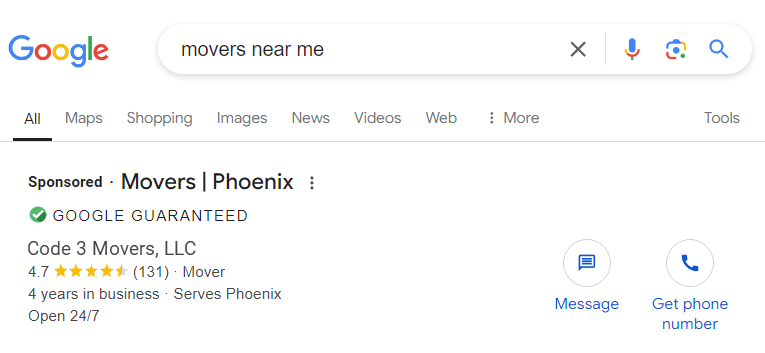
Google Search Ads are the standard 'pay-per-click' format. Bid on high-intent keywords like 'movers near me,' 'moving company [city],' and 'hire movers [date].'
Make sure to send your ad traffic to a dedicated landing page, not your homepage. The page should match what the ad promised and have a clear quote form front and center. Sending people to a generic homepage and making them hunt for a form kills conversions.
Without proper management, the PPC budget disappears fast in a competitive market. Done right, it is one of the fastest ways to get the phone ringing while SEO builds in the background.
97% of consumers read reviews before hiring a local business. Reviews do not just influence decisions. They directly affect where you rank in Google's Local Pack. More frequent, high-quality reviews push you higher.
If you have 15 reviews at 3.8 stars and your competitor has 180 at 4.9, the customer is calling them.
Here’s how you can get reviews:
Ask right after the move. That is when the customer is most relieved and happy. Train your crew to mention it in person, then send a text or email a few hours later with a direct link to your Google review page. Remove every barrier between them and leave a review.
Respond to everything, including bad reviews. A thoughtful response to a complaint builds more trust than pretending it did not happen. Keep it short, take ownership, and offer to resolve it offline. Potential customers read how you handle problems. It tells them a lot about how you would handle theirs.
Diversify your platforms. Google first, then Yelp, and BBB. The more places you have consistent, positive reviews, the stronger your overall reputation.
Never offer incentives for reviews or filter out unhappy customers before asking. Google's policies prohibit it, and violations can get your reviews removed.
Not everyone searching online is ready to book right now. Some are planning ahead. Some are comparing costs. Content marketing puts you in front of all of them early, so when they are ready, you are the name they already recognise.
The content that works best for moving companies:
Moving cost guides. 'How much does it cost to hire movers in [City]?' is one of the most searched questions in the industry. A clear, honest answer on your website pulls in people who are actively planning a move.
City guides, like ‘Moving to Austin, TX? Here’s what to know,’ attract people locating to your area before they have even picked a mover.
Packing tips and checklists are shared widely, and they can earn backlinks from other sites naturally.
FAQ pages show up in Google's 'People Also Ask' sections. Short, direct answers to these capture a steady stream of traffic.
A well-written article published today can bring in leads two years from now at zero additional cost.
These three are amplifiers that support everything else and add volume when used with intention.
Social media: Facebook is still the most relevant platform for local movers. Post real content, like your crew on a job, a packing tip, or a customer review. For better ROI, run retargeting ads to people who visited your website but did not book. They already know you, so they cost far less to convert than cold traffic.
Email: Every quote request that did not book is a warm lead. A two or three-email follow-up over a couple of weeks brings back a real percentage of them. Touch base with past customers occasionally, too. People move more than once, and they refer others.
Referral partnerships: One solid relationship with a busy real estate agent can send you dozens of leads a year. Reach out, be useful, and stay in touch. This compounds quietly over time.

By now, you’ve probably realised something. What actually drives consistent bookings is how all of these pieces work together as a system, and that’s where most companies get stuck.
You either try to manage everything yourself and run out of time, or you hire a general marketing agency that treats your business like any other local service. They might improve one channel, but they rarely understand how the moving industry actually works.
That’s where you need specialized agencies, like Mover Search Marketing. Founder Bryan Bloom spent over 11 years running a moving company before starting the agency, so every strategy is grounded in how the moving business actually works. The agency offers dedicated services for SEO, Local SEO, Google Business Profile, Google Local Service Ads, PPC, AI Search, and website design, with each channel managed separately rather than bundled together.
The AI Search piece is worth calling out. As more people ask ChatGPT, Gemini, and Perplexity to recommend movers instead of searching Google, appearing in those answers matters. Mover Search Marketing's GEO and AEO services are built specifically for that, making sure your business shows up across both traditional and AI-driven search.
Here’s a case study.
Wirks Moving and Storage, from Atlanta Metro, started with 28 first-page keyword rankings in one of the country's most competitive markets. With Mover Search Marketing, Wirks grew to over 1,500 first-page rankings in about a year, with a 1,550% increase in monthly traffic.
If you want a lead pipeline built by people who understand the moving business from the inside out, Mover Search Marketing is the place to start.
Generating leads for your moving company does not have to feel like a shot in the dark. It starts with showing up where your customers are looking, and giving them every reason to call you instead of the competition.
All of this sounds overwhelming, but you do not have to do all of it at once, or alone. Start with your Google Business Profile and your website, then consider a trusted agency when you are ready to scale. Get those right, and you will start seeing movement. Then build from there.
Every month without a lead generation strategy is a month of bookings going to someone else. The guide is right here. What happens next is up to you.
 AI tools to find & convert leads.
  Send emails at scale